
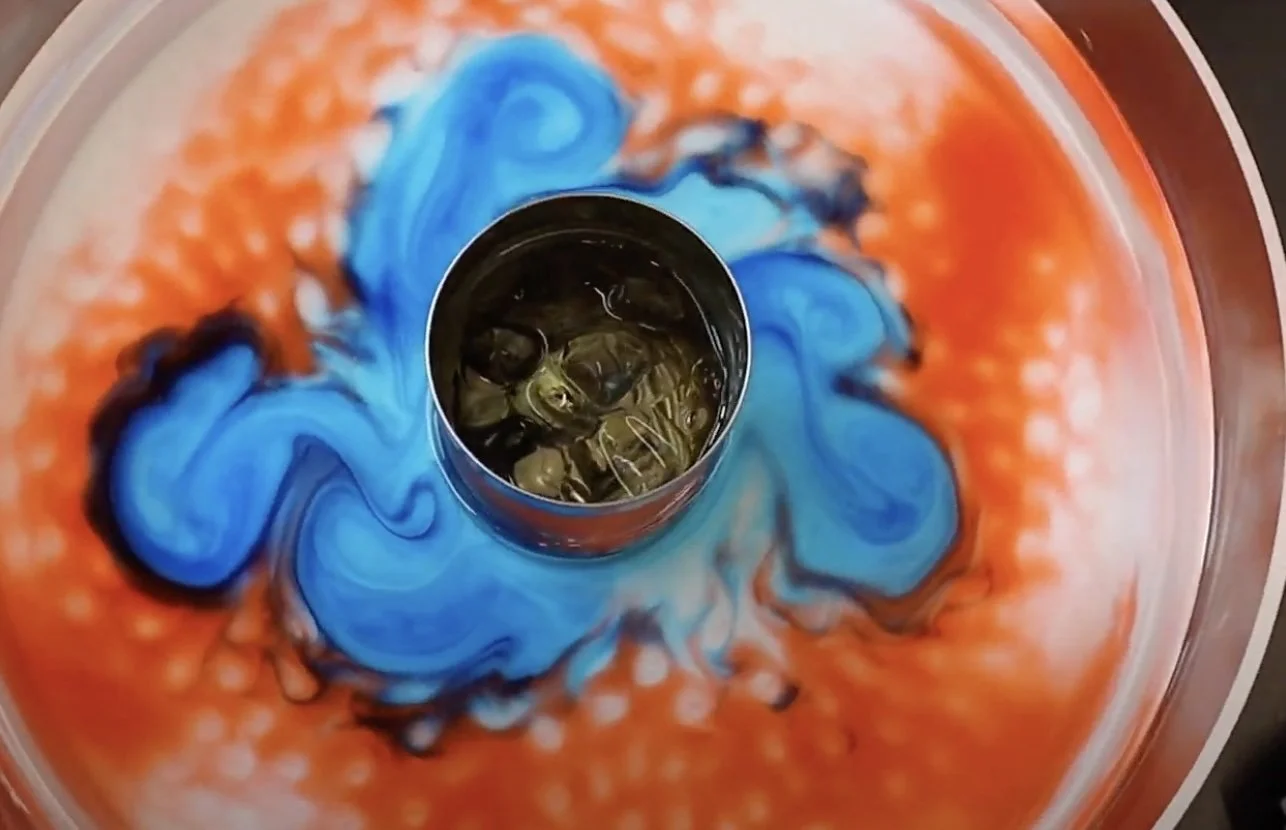
Reducing Surface Tension
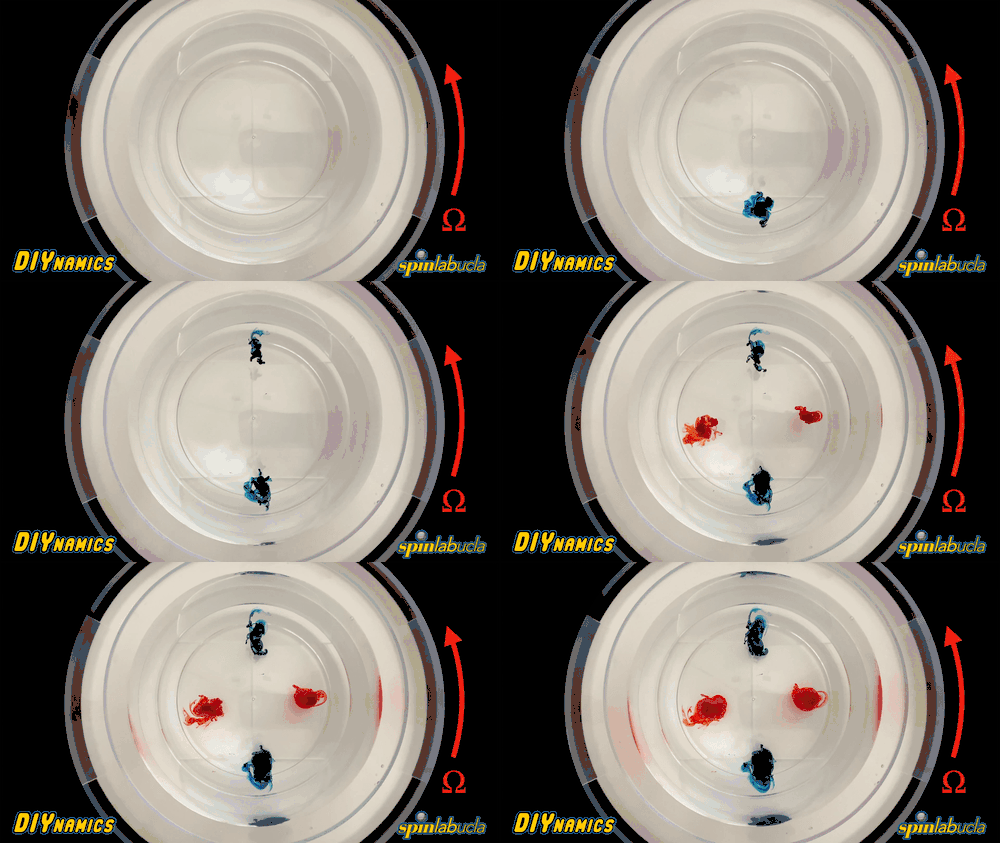
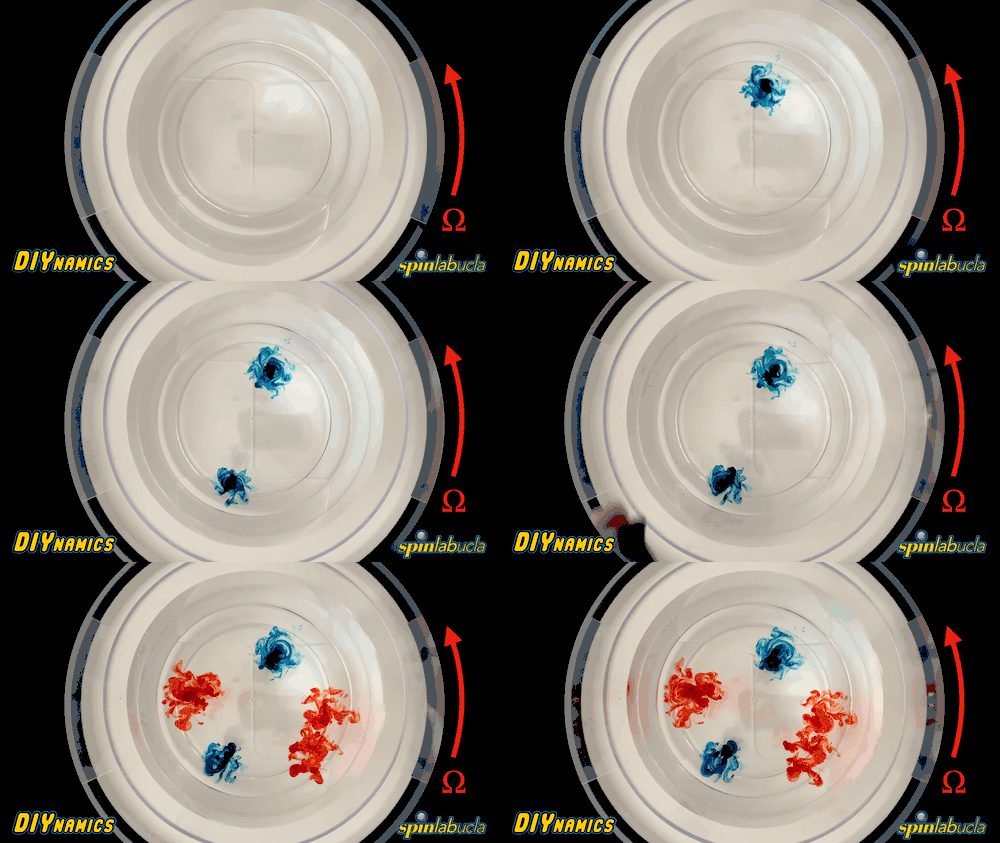
Water with (L) and without (R) surfactant added. Surfactant breaks the water’s surface tension by reducing attraction between its molecules. Notice how food coloring dropped into the water with surfactant remains tight — the food coloring is free to move through the water’s surface. Meanwhile, when food coloring is dropped into the water without surfactant, it disperses — the food coloring encounters resistance at the water’s surface and spreads out before moving through. Note that Ω indicates the rotation direction.
Surface tension refers to the integrity of a liquid’s surface caused by attraction between molecules. The property of liquids results in the liquid’s surface acting as a sheet rather than dissipating. Water is characterized by a high surface tension. As a result, when adding food coloring to water, the water’s surface resists the food coloring.
Surface tension is detrimental to many experiments because the resistance at the liquid’s surface detract from the fluid dynamics of its body — our region of interest. Note that surface tension is an interesting property of liquids to study! Surface tension is key to the natural world (e.g. insects walking on water).
To reduce surface tension, we can add a surfactant or compound that reduces attraction between molecules to the water. Dish soap is an everyday example of a surfactant. Add a drop of dish soap into the water before starting your experiment. This will break the surface tension at the water’s surface thus reducing resistance and allowing us to study the fluid dynamics of its body.
Recommended Parts - Dish Soap